
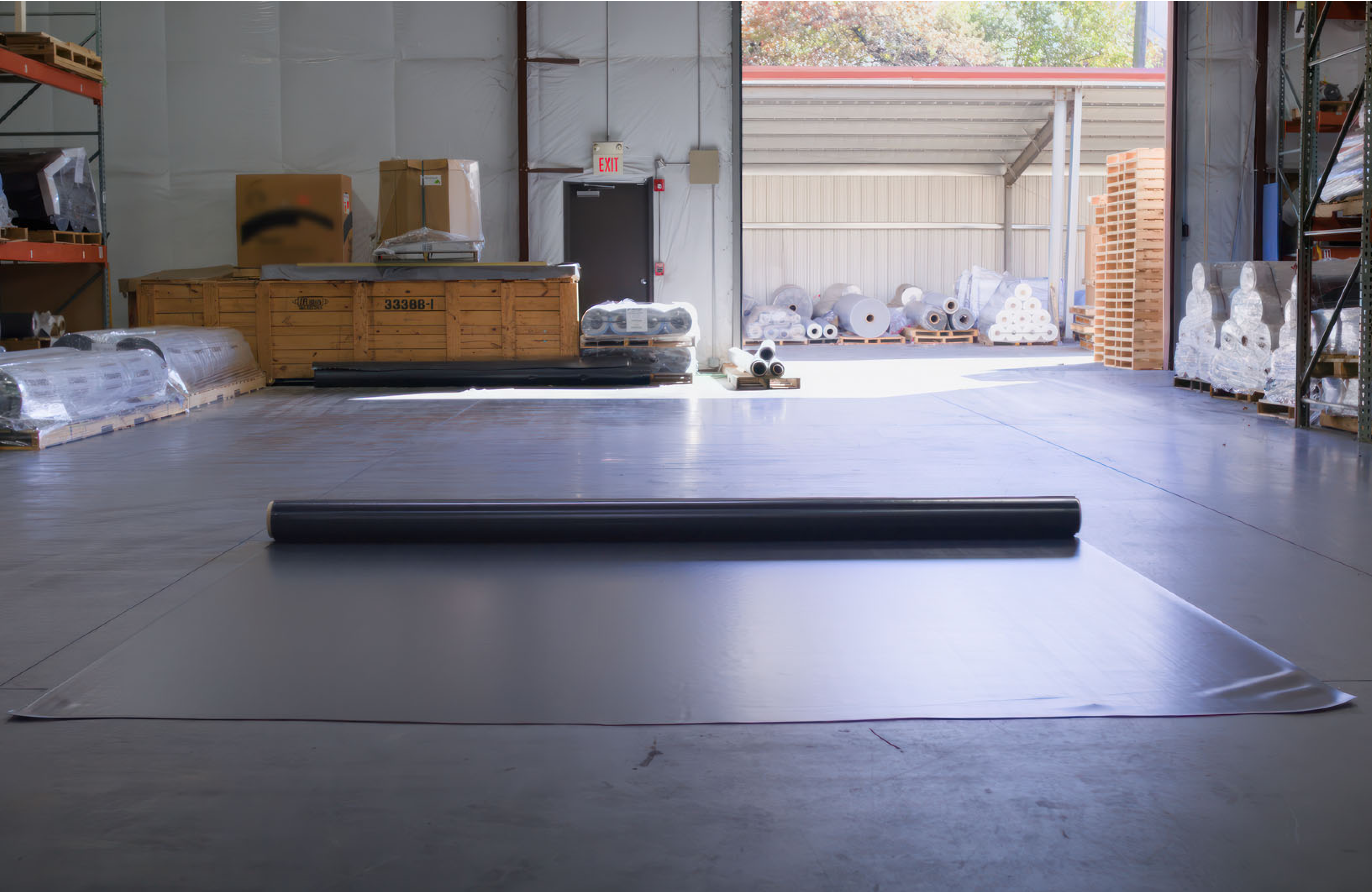
A polyvinyl chloride (PVC) geomembrane is a flexible, single-ply impermeable liner with an array of uses across water containment, detention, and controlled-environment applications. Some of the most common uses for PVC geomembranes include coal ash containment, reservoir liners, pond liners, water retention systems, and below-grade waterproofing.
Not all PVC geomembranes have the same properties, and material specifications can have a significant impact on performance. This means that understanding the various properties of PVC geomembranes is essential in selecting the right solution for your project.
Ronald Mark Associates has over 40 years of experience in formulating flexible PVC products that meet the exacting ASTM D7176-22 standards, including our market-leading XTRM PLY® PVC geomembranes.
In this article, we will break down the various properties of PVC geomembranes with actual specification data, helping engineers and fabricators to understand what these specs mean and evaluate material properties against project requirements.
What Makes PVC the Right Base Material for Geomembranes
PVC’s inherent flexibility allows it to conform to irregular surfaces and absorb ground movements without cracking. As a base geomembrane material, this gives it a significant advantage over stiffer liner materials, which tend to require more site preparation in advance of installation.
This flexibility also enables easier factory fabrication. Large panels of PVC can be folded and delivered to the project location in a ready-to-deploy state, significantly reducing the need for field seaming. This speeds up installation and reduces labor costs.
PVC also offers a long service life. When correctly installed, PVC geomembranes can offer a documented service life of 20 to 50 years in buried applications. For long-term infrastructure projects where liner replacement is costly, this makes it a cost-effective choice.
PVC compounds can be engineered to specific performance targets. Whether your project requires enhanced impermeability, greater UV resistance, or low-temperature flexibility, the exact formulation of your PVC geomembrane can be adjusted to meet these needs. And, since PVC can be welded via hot air, wedge, chemical, or RF welding, it offers installers and fabricators multiple options suited to both on-site and factory conditions.
Key Material Properties and What They Mean for Your Project
In this section, we will explore the key material properties of PVC geomembranes using real specification data and examine how these properties connect to real-world engineering and fabrication concerns.
Flexibility and Elongation
PVC offers a tensile elongation of 380 to 450% depending on its thickness, per ASTM D882. This means that the membrane can stretch significantly under stress before reaching the point of failure, making it ideal for installations over uneven subgrades or in applications with significant hydrostatic pressure variation.
PVC’s flexibility also reduces the need for the specialized installation equipment that may be required to install stiffer liner materials, offering a practical advantage that is particularly relevant for complex or remote job sites.
Finally, PVC’s low-temperature impact rating of -29°C (30mil to 60mil, per ASTM D1790) ensures that it continues to perform well in installations in cold climates without the risk of becoming brittle.
Impermeability
PVC geomembranes offer an impressive hydrostatic resistance of 100 to 180 PSI across the thickness range (30mil to 60mil, per ASTM D751). This provides a specific benchmark for containment integrity under water pressure. And, with their water extraction loss capped at 0.15% per ASTM D792, PVC geomembranes do not absorb or transmit water through their material.
However, a word of caution to installers and fabricators: the impermeability of a membrane is only as good as its seams. PVC geomembranes’ seam shear strength of 58.4 to 116 pounds per inch and peel strength of 15 pounds per inch (30mil to 60mil, per ASTM D882) sets a measurable and consistent standard for seam performance in both field and factory conditions.
Dimensional Stability and Lay-Flat Quality
With a dimensional stability of ±3% (30mil to 60mil, per ASTM D1204), PVC geomembrane sheets are able to maintain their geometry under thermal cycling. This is critical in applications in which expansion and contraction could stress the seams or anchor points of a membrane.
PVC’s lay-flat quality means that a typical PVC membrane arrives square and flat. This reduces installation time and eliminates localized stress concentrations before the first seam is made, creating smoother and more cost-effective installation processes.
Dimensional stability and lay-flat properties are both quality-control outcomes, meaning that in-line material inspection during production is crucial. At RMA, we conduct robust quality control on every geomembrane before it leaves our manufacturing facility, ensuring that it arrives at your worksite in premium condition and ready for your project.
Durability and Resistance
PVC offers an impressive soil burial break strength retention, with a maximum of 5% loss (per ASTM G160). This ensures consistent and reliable structural integrity in subgrade applications even over long periods of time.
With a tear strength of 8 to 15 pounds (30mil to 60mil, per ASTM D1004), PVC membranes are able to withstand the demands of wide and heavy panels even before the membrane is installed.
Thickness and Width: Matching Spec to Application
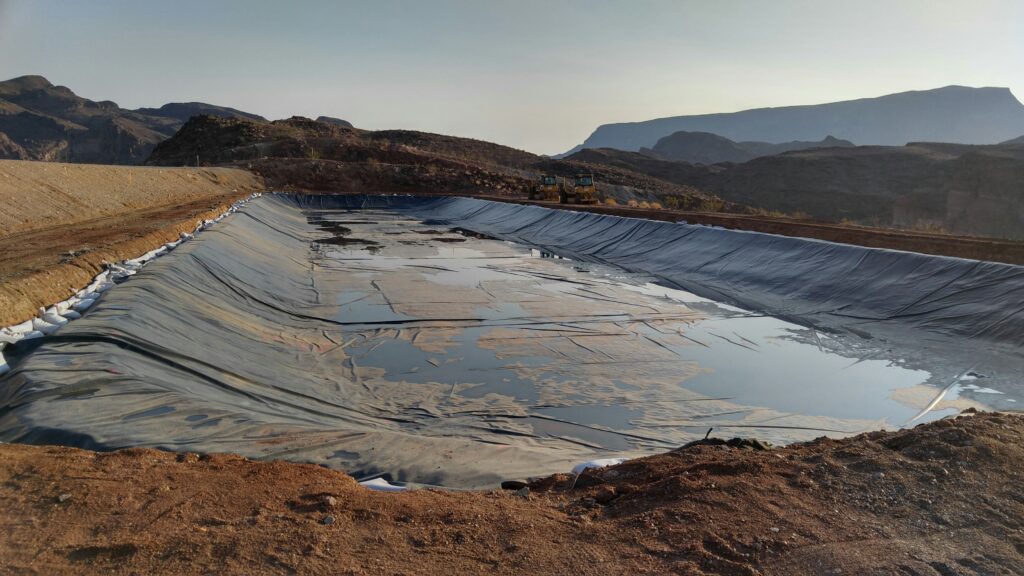
Selecting the right formulation and configuration of PVC geomembrane is a significant concern for engineers and fabricators. But, with so many products on the market, it is not always straightforward. In this section, we will offer a simple and practical framework for choosing the best thickness and width for your project.
PVC geomembranes with heavier thicknesses, available up to 60mil, deliver higher hydrostatic resistance of up to 180 PSI as well as greater tensile strength and greater tear strength. This makes them the choice for high-load or long-service applications such as retention walls and reservoir liners.
30mil membranes, on the other hand, are suitable for a wide range of standard containment applications and are available in 200-foot contractor rolls. This convenient solution simplifies logistics and eases the installation process for field fabrication teams.
RMA’s PVC geomembranes are available in sheets of up to 120” in width. This means fewer seams are required per project, reducing potential points of failure and lowering labor requirements for both fabrication and installation.
How Width Affects Seam Count and Why That Matters
When you install a PVC geomembrane, every seam is a potential failure point. This is not because seaming is unreliable, but because it introduces variability that no specifications can fully eliminate. Therefore, reducing seam count is the most direct way to reduce this variability. Wider sheets offer the simplest solution to this problem.
For fabricators, fewer panels mean simpler geometry, less handling, and faster production throughput. For engineers, fewer field seams means fewer inspection points and lower installation risk. This is particularly important for water retention and detention applications, where the consequences of a liner failure can be severe.
Wider panels also reduce the amount of destructive testing required for both factory-fabricated and field-installed seams. This can reduce inspection overhead and lower overall project costs.
Compliance with the ASTM D7176-22 and BABAA standards ensures adherence to standardized specifications and procurement baselines, which are of particular concern for public infrastructure and municipal projects.
Choosing a Geomembrane on Spec, Not on Faith
PVC geomembrane performance is determined at both the compound and manufacturing levels. The precise specifications of a particular membrane make this performance verifiable and enable engineers and fabricators to select the most suitable membranes for their projects. Users must select the appropriate thickness and width, as well as a matching configuration to the application.
From flexibility and impermeability to dimensional stability, resistance, and fewer seams as a structural advantage, the specific properties of a PVC geomembrane map to specific project-stage concerns: fabrication, installation, and long-term service. To reduce installation risk and ensure long-term containment integrity, engineers must take all stages into account when selecting an appropriate PVC geomembrane for any given project.
If you would like to learn more about our XTRM PLY® PVC geomembranes, please contact RMA directly to request detailed technical specifications and availability.
related posts

February 20, 2025
A recreational vehicle, or RV, is a type of home on wheels. [...]
September 14, 2026
Polyvinyl chloride (PVC) is a versatile material suitable for numerous uses. One [...]
March 13, 2026
Anyone who has owned an RV for some time will know that [...]