
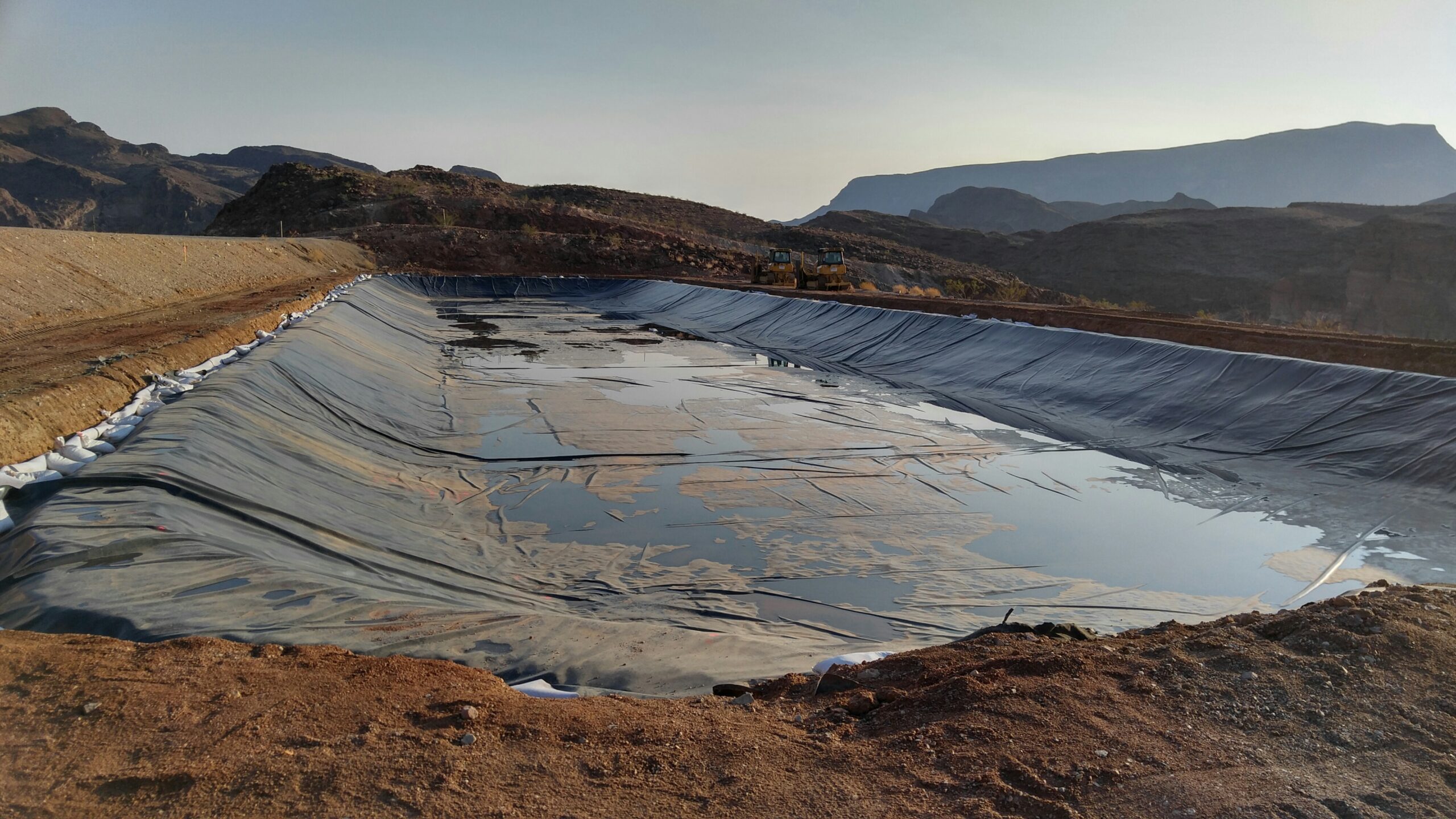
Geomembrane liners–thin, impermeable sheets typically made from synthetic materials and designed to contain liquids, gases, or chemicals–find use in a wide variety of applications in the construction, water containment, environmental protection, and waste management sectors and beyond.
Selecting the best material for a liner for any given project requires an in-depth understanding of the characteristics and performance of the various options available. Polyvinyl chloride (PVC) exhibits many traits that make it an ideal material for geomembrane liners. One of the properties for which it is most prized is its flexibility.
Uneven terrain is a common issue for fabricators and installation teams working with geomembranes. It is also one of the biggest cost drivers in containment system projects, since surface and subgrade conditions directly impact installation complexity, liner performance, and even the expected lifespan of a liner once it is in place.
A geomembrane’s flexibility determines how well it will conform to these irregular surfaces and subgrades. This directly impacts the amount of preparation a site will need prior to installation, the amount of cutting and seaming engineers will need to perform, and the level of installation expertise required. These factors, in turn, have implications for the project’s overall cost.
In this post, we will explore why geomembrane flexibility matters when working on uneven ground, how PVC’s flexibility impacts its functionality in real-world conditions, and what this means for site preparation requirements and project costs.
Why Uneven Terrain Complicates Geomembrane Installation
Subgrade condition is one of the most critical factors in the performance and longevity of lining systems. Protrusions, rocks, or debris can puncture a liner during installation or place additional stress on it over time, shortening its lifespan.
Many of the stiffer liner materials on the market do not conform so well to uneven surfaces. This means that installation teams must perform far more extensive grading, compaction, and bedding preparation to achieve a workable surface before the liner is installed. It may also mean more seams are required, joining together multiple pieces to create a membrane suitable for an irregular project site.
Site preparation and seaming take time. This means that they often account for a large share of the total installation time (and therefore cost) of containment projects. In order to keep projects within budget, engineers must therefore take site conditions and seaming requirements into consideration as a major factor when selecting geomembrane liner materials.
In addition, the condition of a subgrade and how well a liner conforms to it can affect the integrity of the liner over time. Choosing a material that does not conform well to its surface can significantly weaken a liner and ultimately cause it to fail sooner.
How PVC’s Flexibility Conforms to Irregular Surfaces
Pure PVC is a hard, brittle, and inflexible material. However, when plasticizers are added, they weaken the forces holding the material’s molecules together and space out its polymer chains, creating a strong yet soft and highly flexible PVC. It is this material that helps engineers address the problem of uneven and irregular surfaces when installing geomembrane liners.
The flexibility of this form of PVC allows geomembranes to conform closely to complex, uneven, or irregular ground rather than bridging over gaps or protrusions. While stiffer materials are prone to wrinkling or standing away from the subgrade, this conformability reduces stress concentration at seams and low points.
RMA’s XTRM PLY® PVC geomembranes are engineered specifically to offer this kind of flexibility without compromising liner strength and integrity, supporting complex field conditions without requiring specialized handling equipment. Available in 30, 40, and 60 mil thicknesses and in a variety of widths up to 120 inches, these membranes find use in water retention, pond lining, canal lining, water detention, and below-grade waterproofing projects.
Reduced Site Preparation and Lower Installation Costs
Because PVC conforms readily to the ground profile of a site, including those with uneven subgrade and complex existing features, less extensive grading and compaction are typically needed compared to stiffer alternatives.
This does not, of course, mean that no preparation is required. Basic subgrade preparation, such as clearing protrusions and installing appropriate bedding, is still vital. Engineers and installation teams should ensure that the surface is as uniform as possible, well compacted, and free of debris such as rocks, plant matter, and construction debris prior to installation.
However, the degree of subgrade correction required will be far lower when a geomembrane liner itself can accommodate minor irregularities without compromising its performance or integrity. Strong yet flexible geomembrane materials, such as PVC, are the solution.
Fewer site preparation requirements translate directly into fewer labor hours and less equipment time, which together account for a meaningful share of the total project cost and can make a significant difference to the bottom line. The smaller number of field seams needed when working with PVC geomembranes, enabled by wide-width panels, compounds these labor and cost savings further.
Since installation and logistics can add 15% to 50% or more to a project’s costs, in addition to the costs of materials and equipment, project managers can save a significant amount of money simply by choosing options that reduce these financial burdens.
Flexibility as a Practical Advantage for Diverse Sites and Projects
Though various material options are available and each comes with its own benefits and drawbacks, PVC geomembranes are a practical choice and show clear benefits across a variety of applications. Its flexibility reduces the grading and site preparation work required, lowering both labor and equipment costs for projects carried out on uneven terrain.
The potential for PVC geomembranes to be delivered as wide-width, factory-fabricated panels further increases cost savings by reducing the need for field seaming.
If you would like to learn more about any of Ronald Mark Associates’ XTRM PLY® PVC geomembranes, request specification details, or seek project-specific guidance on the best geomembranes for your needs, please contact RMA and a member of our knowledgeable team will be pleased to advise you.
related posts
January 16, 2025
Polyvinyl chloride (PVC) is a high-strength synthetic polymer and one of [...]
December 18, 2024
Polyvinyl chloride (PVC) is a synthetic thermoplastic polymer that is used extensively [...]
March 24, 2026
To: Our Partners in PVC Roofing, Geomembranes, and Reinforced LLDPE Liners By [...]