
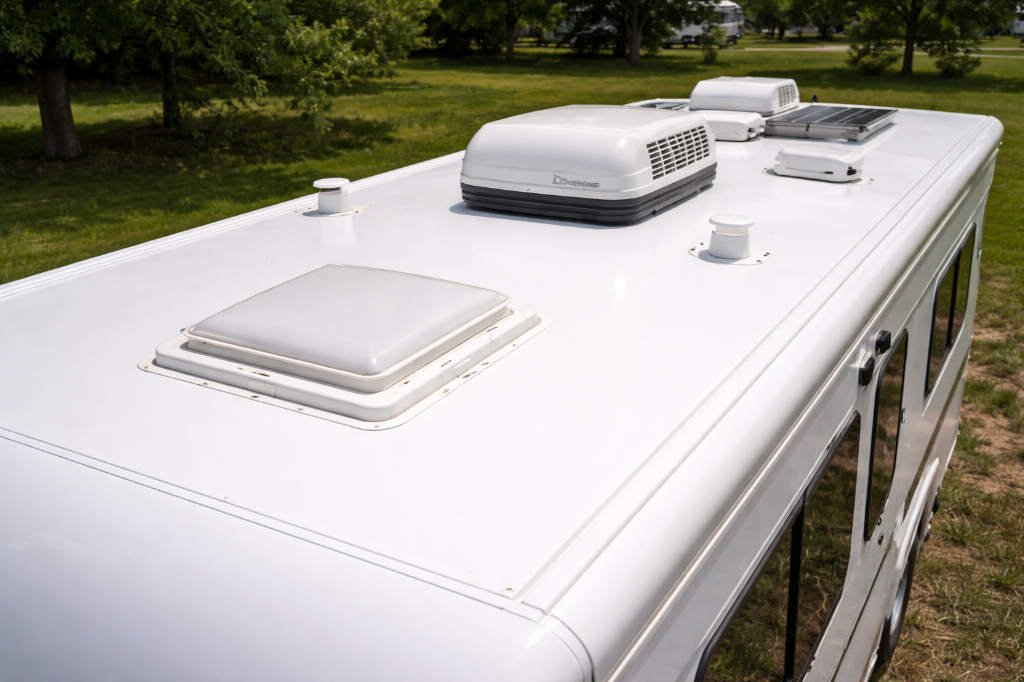
For RV manufacturers focused on improving energy efficiency and interior comfort, roofing performance is a critical design consideration, particularly as customers increasingly expect reliable comfort in hot-weather travel and extended seasonal use. The roof is the most sun-exposed surface of an RV, making its ability to reflect and release heat essential for managing thermal load, reducing cooling demand, and supporting stable interior conditions during peak sun exposure and throughout the day.
White PVC roofing membranes are widely used in RV applications because they help limit heat gain during peak sun exposure while offering consistent, repeatable performance across production. By reflecting infrared (IR) radiation and efficiently releasing absorbed heat, reflective PVC roofs help maintain cooler interiors, reduce strain on onboard climate-control systems, and provide more consistent comfort in warm conditions.
In the sections below, we examine the roof-performance characteristics that matter most: infrared (IR) reflectivity, peak heat protection, and high emissivity. Additionally, we will explain how each supports energy-efficient, comfort-driven RV design.
How Reflecting Infrared Light Reduces Heat Gain
Solar energy includes infrared (IR) radiation, which is responsible for most heat buildup in an RV. When the roof absorbs IR energy, it is converted into heat that transfers directly into the living space below.
A highly reflective roof prevents much of this heat-generating IR radiation from entering the unit. White PVC RV roofing is designed to reflect a significant portion of incoming solar energy, helping keep rooftop temperatures lower throughout the day. This high reflectivity is supported by whitening agents, such as titanium dioxide, which contribute to a bright white surface that efficiently reflects infrared light.
By reflecting solar energy at the roofline, less heat is allowed to penetrate the RV, reducing interior temperature rise and lowering reliance on air conditioning.
Why Roof Reflectivity Matters Most During Peak Heat Hours
The roof experiences the highest thermal load during the hottest part of the day, when the sun is at its most direct angle. During these peak hours, roof reflectivity has a far greater impact on heat mitigation than wall reflectivity.
This principle is commonly applied in other high-heat environments. White-painted school bus roofs and white warehouse roofs, for example, are frequently used in hot climates to limit interior heat buildup during midday sun exposure. The same logic applies to RVs, where the roof remains continuously exposed to direct sunlight.
When the sun is lower in the sky, as is common during early morning or evening hours, solar intensity decreases, and ambient temperatures typically begin to fall. At these times, the walls receive less concentrated solar energy, making them less critical to overall heat control. For this reason, the roof remains the primary pathway for heat gain and the most critical surface for thermal mitigation.
A highly reflective RV roof provides peace of mind by limiting heat intrusion precisely when temperatures and solar intensity are at their highest.
High Emissivity Helps the Roof Cool Faster
In addition to reflectivity, emissivity plays a key role in roof thermal performance. Emissivity refers to a material’s ability to release absorbed infrared energy rather than retaining it.
PVC has a naturally high emissivity compared to many commonly used polymer roofing materials. This means that when the roof surface absorbs heat, it releases that energy back into the environment efficiently, rather than transferring it into the RV interior. As a result, the roof cools down more quickly once solar intensity decreases.
The combination of high reflectivity and high emissivity enables PVC roofing to manage heat effectively throughout the day, resulting in lower rooftop temperatures and improved interior comfort.
White PVC Roof Performance Supports RV Energy Efficiency and Comfort
As detailed earlier, white PVC roofs offer multiple advantages for RV manufacturers seeking materials that improve thermal performance and energy efficiency at the roofline.
By reducing heat gain at the roof, reflective PVC roofing plays a central role in managing thermal performance within an RV. When a roof reflects a high percentage of incoming solar radiation, less energy is converted into heat at the surface. This directly limits conductive heat transfer into the living space below, helping prevent rapid interior temperature increases during sun exposure.
Reflective roofing is essential in RV applications because of the vehicle’s compact interior volume and limited thermal mass. Unlike residential buildings, RVs have minimal buffering capacity against external temperature swings. Heat entering through the roof can quickly raise interior temperatures, making effective heat mitigation at the roofline essential. A reflective PVC roof helps slow this temperature rise, providing a more controlled and comfortable interior environment throughout the day.
Extended exposure to high daytime temperatures is common in many RV use scenarios, including travel through warm regions, prolonged outdoor storage, or stationary use at campsites without shade. During these conditions, a reflective roof provides continuous protection against solar heat gain, reducing interior temperature buildup over time rather than allowing heat to accumulate hour after hour.
In addition to improving comfort, controlling rooftop heat supports broader energy-efficiency goals. Lower cooling demand reduces strain on onboard power systems, which is particularly valuable when operating on battery power, generators, or limited electrical hookups. By helping maintain manageable interior temperatures, reflective PVC roofing contributes to more efficient energy use and improved system reliability.
Overall, managing heat at the roof surface is one of the most effective strategies for improving RV thermal performance. High-reflectance PVC roofing supports energy efficiency, interior comfort, and practical day-to-day usability, making it a valuable component in RV designs intended for warm climates and high sun exposure.
Key Takeaways for RV Manufacturers
A reflective RV roof plays a critical role in managing heat and supporting energy-efficient design. White PVC roofing membranes help keep IR radiation out of the unit, protect against peak daytime heat, and release absorbed energy efficiently through high emissivity.
By prioritizing roof reflectivity, RV manufacturers can improve thermal performance, reduce cooling loads, and enhance interior comfort when it matters most.
For teams evaluating material options or exploring ways to enhance reflectivity in RV roofing applications, we’re available to discuss material performance considerations and help identify solutions that align with your goals.
related posts
December 15, 2025
For RV manufacturers focused on improving energy efficiency and interior comfort, roofing [...]
February 20, 2025
A recreational vehicle, or RV, is a type of home on wheels. [...]
January 16, 2025
Polyvinyl chloride (PVC) is a high-strength synthetic polymer and one of the [...]