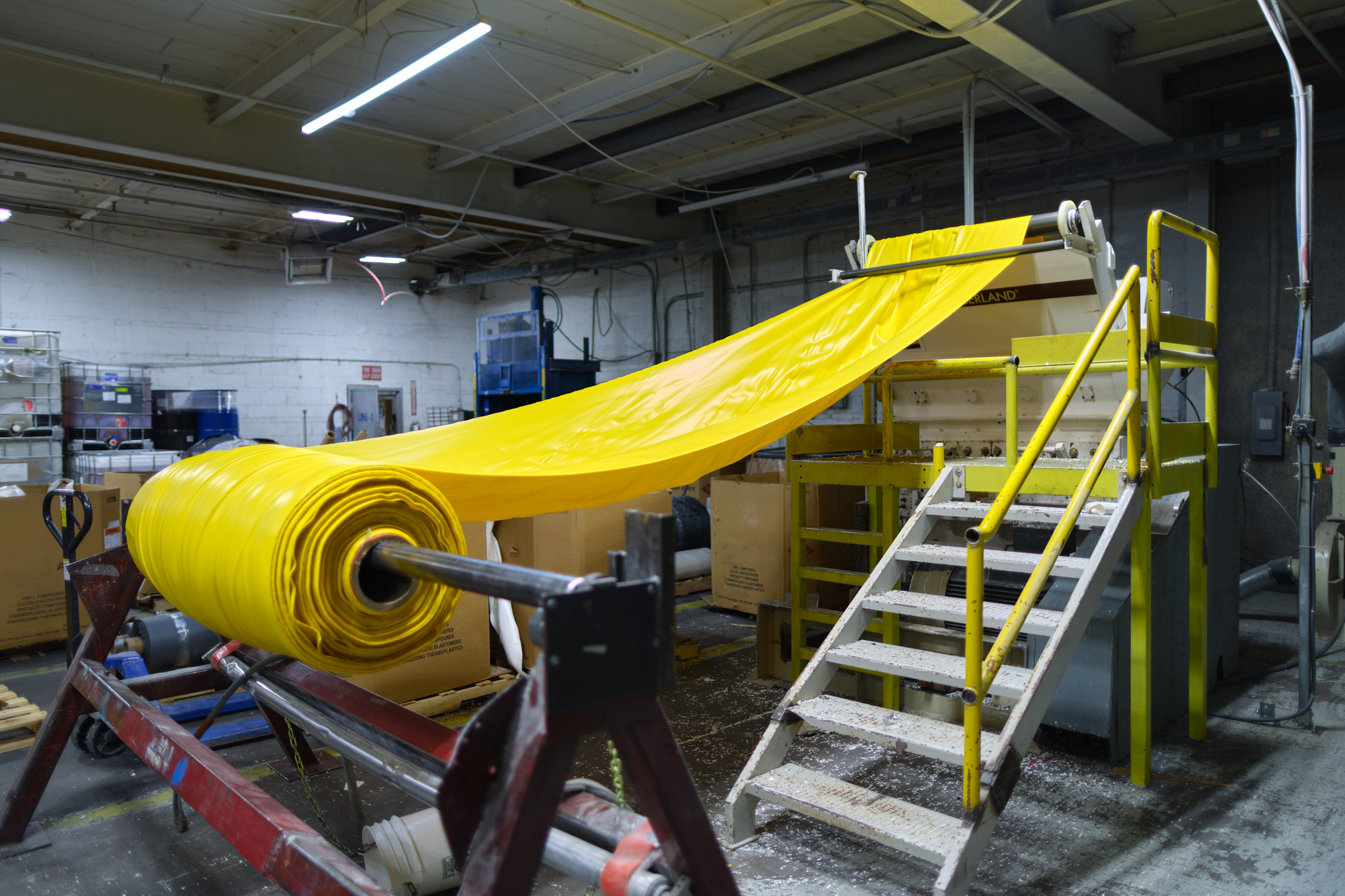
Toll coating is a manufacturing service in which a brand owner supplies a formula, specification, or concept, and a specialist coater then handles the production using their own equipment, materials, expertise, and facilities.
The toll coating production model exists because setting up an in-house polymer coating line requires substantial capital, specialized machinery, trained staff, and ongoing process management. Most brand owners are not equipped to handle these requirements and, in many cases, it is neither cost-effective nor necessary to bring production in-house.
In this article, we will explore toll coating in detail, exploring what the arrangement entails, the benefits to brand owners, when outsourcing makes financial sense, and what key qualities to look for in a toll coating partner.
What Toll Coating Is and What It Isn’t
A toll coater takes a brand owner’s formula, concept, or specifications and manufactures the finished material accordingly. They then ship the final product under the brand owner’s label.
Toll coating is often combined with a process called private labeling. Under a private labeling arrangement, the finished material is delivered in the brand owner’s packaging and under their name, without any mention of the third-party manufacturer. From the end customer’s perspective, the third-party manufacturer is invisible.
The coater supplies the production infrastructure, including extrusion lines, coating machinery, technical expertise, and quality control systems. The brand owner provides the specification and retains full ownership of the formulation, brand, and customer relationships.
Toll coating is not a licensing agreement or a co-development deal, and the coater has no ownership of or claim to the final product. The brand owner maintains full ownership of their intellectual property.
Beyond standard private labeling contracts, experienced toll coaters can also work with brand owners on hybrid arrangements. This may involve developing modified or custom versions of existing materials that meet specific performance or specification requirements, utilizing the manufacturer’s knowledge and equipment in the development process.
What You Retain as the Brand Owner
Brand owners who are unfamiliar with the toll coating and private labeling model often assume that outsourcing production means relinquishing authority. However, this is not the case. In fact, you retain complete creative control and intellectual property ownership.
If the formulation or specifications to be manufactured originate from the brand owner, they remain the brand’s property. The coater simply executes the recipe. Similarly, finished products ship strictly under the brand owner’s label, ensuring that brand identity is preserved.
End customers interact exclusively with the brand rather than the manufacturer, and the toll coater has no insight whatsoever into who receives or buys the products. All commercial relationships belong entirely to the brand owner.
In short, the brand owner determines what gets made, in what quantities, and to what specifications. They also determine how the product is presented, packaged, and sold. The coater’s role lies strictly in execution.
When Toll Coating Makes More Financial Sense Than Building In-House
Deciding whether to manufacture in-house or outsource production is not always straightforward. In this section, we will explore cases in which outsourcing makes more sense, based on the real costs and practical limits of establishing in-house polymer coating capacity.
Installing a polymer coating line requires wide-format extrusion, lamination equipment, quality assurance systems, and trained personnel. This means investing substantial capital into equipment, facilities, and people before producing a single unit. Many brands simply do not have the resources to make this viable. Toll coating converts these high fixed upfront costs into variable operational expenses.
A toll coater with deep polymer knowledge and experience across multiple material types can produce materials that a brand owner could not economically develop in-house without investing in dedicated lines and specialized expertise for each formula.
In-house manufacturing only becomes cost-effective at volumes high enough to ensure maximum equipment utilization. Below that threshold, operating internally means absorbing the expense of idle capacity. A toll coater, on the other hand, can take on your project as one of many, utilizing their equipment at its full capacity and reducing the per-unit cost.
Finally, toll coating is particularly advantageous in the context of new product development. It allows brand owners to bring a concept to market or even test a hybrid variation without committing to major infrastructure before validating the commercial viability of a product. This makes it easier to gauge demand before deciding whether in-house manufacturing is warranted.
Turnaround and Scalability

Toll coating can provide a more agile, scalable production model with a more efficient turnaround compared to manufacturing in-house. A toll coater’s scalability depends upon their infrastructure, such as equipment footprint and production capacity, rather than the brand owner’s facility or team limitations.
Production line configurations vary significantly in a number of ways, including width and material compatibility. A coater operating multiple specialized lines can assign each job to the optimal setup, maximizing efficiency across the facility.
The multi-facility operations facilitated by some toll coaters can help brands to mitigate operational risks. If one plant experiences scheduling bottlenecks, another facility can step in to absorb the workload without significant disruption or delay to production.
Clients also come to us for toll coating when they want to add to the capacity they already have. For example, if they are experiencing a spike in needs during a particular time of year, we can add capacity to help bridge the gap. If a brand has only one plant or otherwise has limited capacity, a toll coating partnership acts as a kind of insurance.
In addition, importers or brands that have previously brought in products from overseas may now need US-based capacity in order to sell infrastructure projects within the US. Toll coating can make this viable without the need to open an entire new facility.
Project timelines can vary significantly and will ultimately depend on factors such as material choice, technical complexity, and batch size. However, experienced toll coaters will have optimized their processes to offer the most rapid turnaround possible. Always consult directly with your coater to establish precise turnaround expectations before signing a contract.
Certifications and Compliance
Polymer coatings for industrial and commercial applications are often required to carry product certifications such as quality standards, material compliance documentation, or performance testing. This may be expected by end customers and, in some cases, required under industry regulations or the law.
An experienced toll coater is already likely to hold the relevant certifications, test results, and compliance documentation. These can extend to a brand owner’s private label product, sparing the brand owner the time and cost of independently pursuing and maintaining certification. This practical advantage is often overlooked when considering whether to outsource production.
This is particularly relevant in construction applications such as geomembranes and roofing materials. Engineers, specifiers, and procurement teams routinely require compliance documentation before approving the purchase of products in these categories.
If you are a brand owner considering the toll coating production model, always ask your prospective toll coating partner which certifications they hold and how the transfer process works.
How Confidentiality Is Handled
One of the biggest concerns brand owners have regarding toll coating is that outsourcing production risks compromising proprietary information. In fact, when you choose a reputable partner, this is not the case.
Toll coating agreements are inherently built on strict confidentiality. The coater manufactures the product strictly to the client’s specifications, without public disclosure. Finished products are then shipped under the brand owner’s name and packaging, with zero reference to the manufacturer.
The coater’s client lists, active specifications, and partnered brands remain completely confidential. Likewise, the brand owner’s formulas, market strategy, and applications stay entirely protected. The toll coating partnership is built on mutual trust and respect. It is not in the coater’s interests to compromise the confidentiality of their clients.
For additional peace of mind for both parties, formal non-disclosure and confidentiality agreements are standard practice before production begins. If you are a brand owner evaluating potential toll coating partners, always ask specifically about confidentiality and ensure that these protections are in place before sharing proprietary information.
Ronald Mark Associates is ISO 9001-certified and audited by FM, UL, and NSF. We have served as a trusted, silent manufacturing partner to brands of all sizes across the geomembrane, roofing, and specialty coatings sectors for more than 50 years. We would love to help you bring your product to market at a fraction of the cost of in-house manufacturing. Please reach out to discuss your project requirements or ask any questions.
related posts
July 21, 2026
A polyvinyl chloride (PVC) geomembrane is a flexible, single-ply impermeable liner with [...]
March 13, 2026
Anyone who has owned an RV for some time will know that [...]
January 16, 2025
Polyvinyl chloride (PVC) is a high-strength synthetic polymer and one of [...]